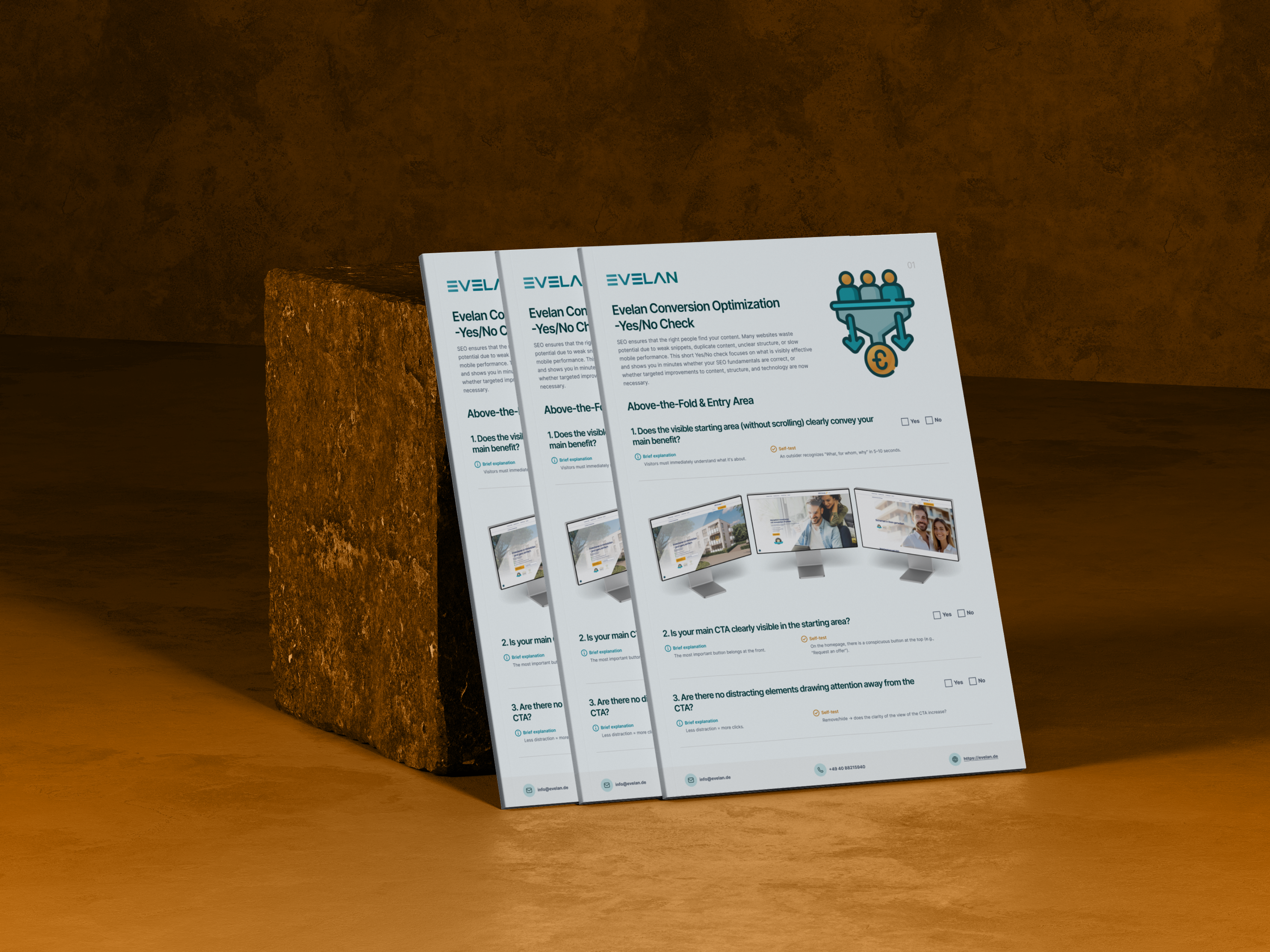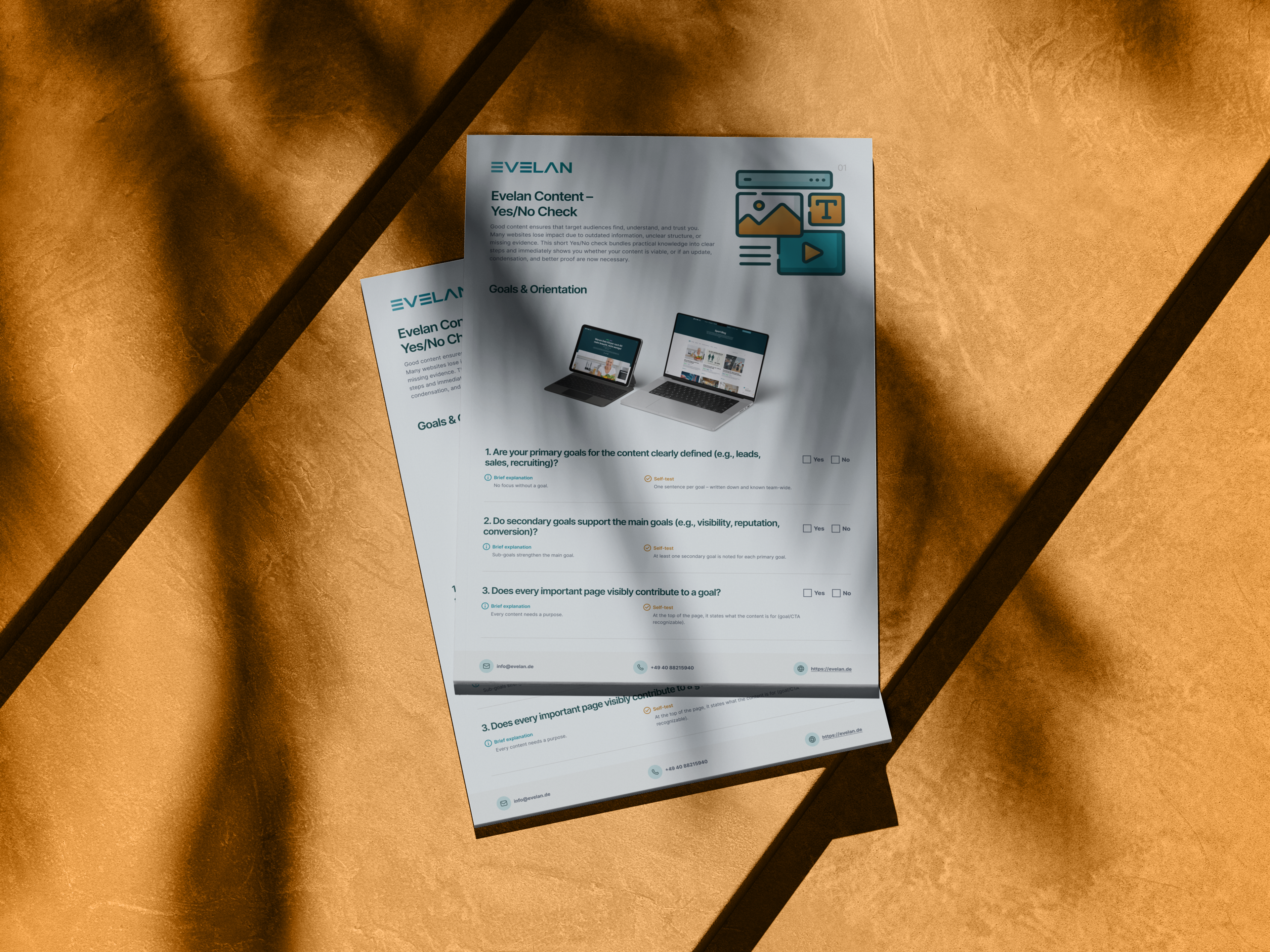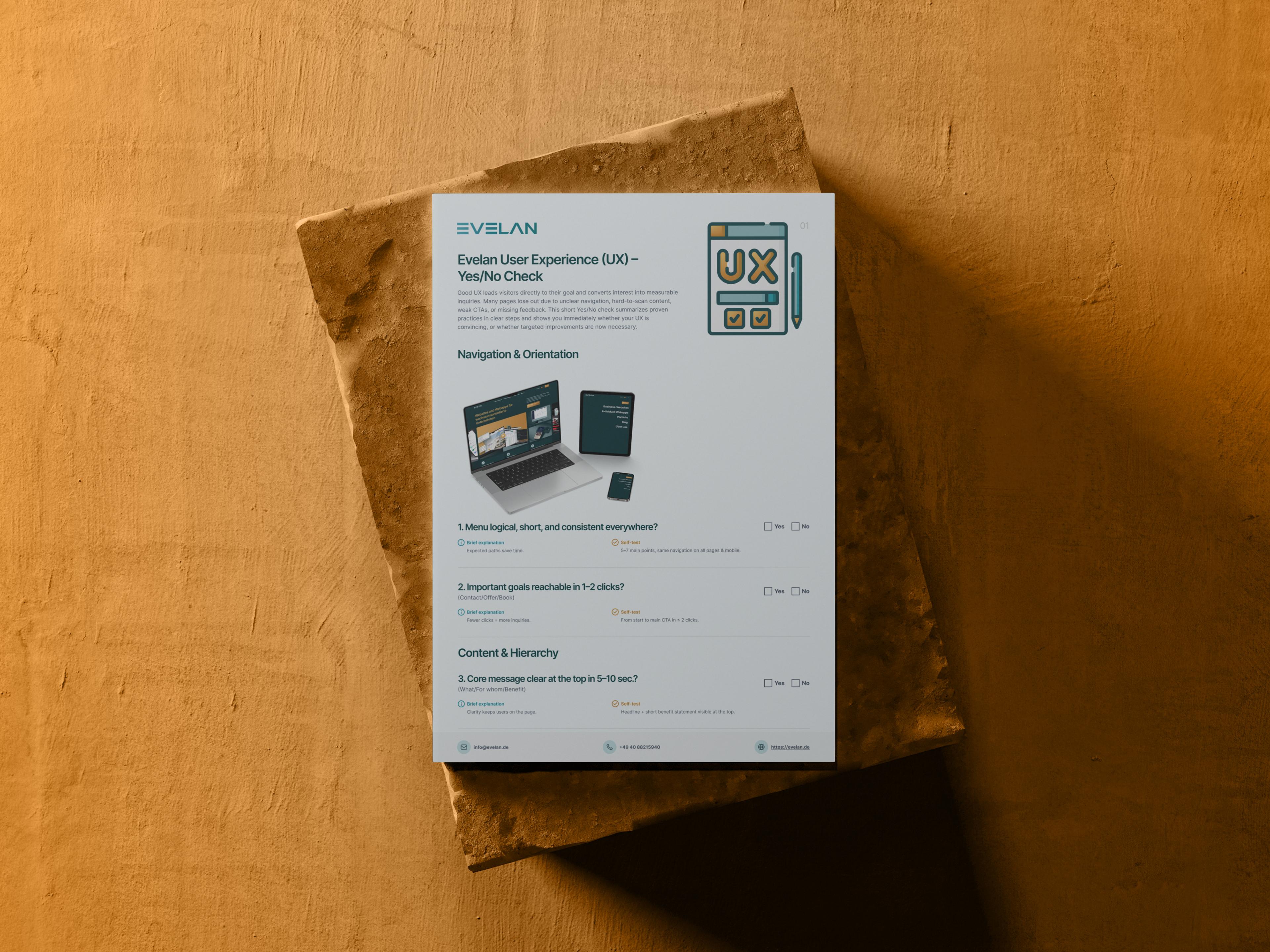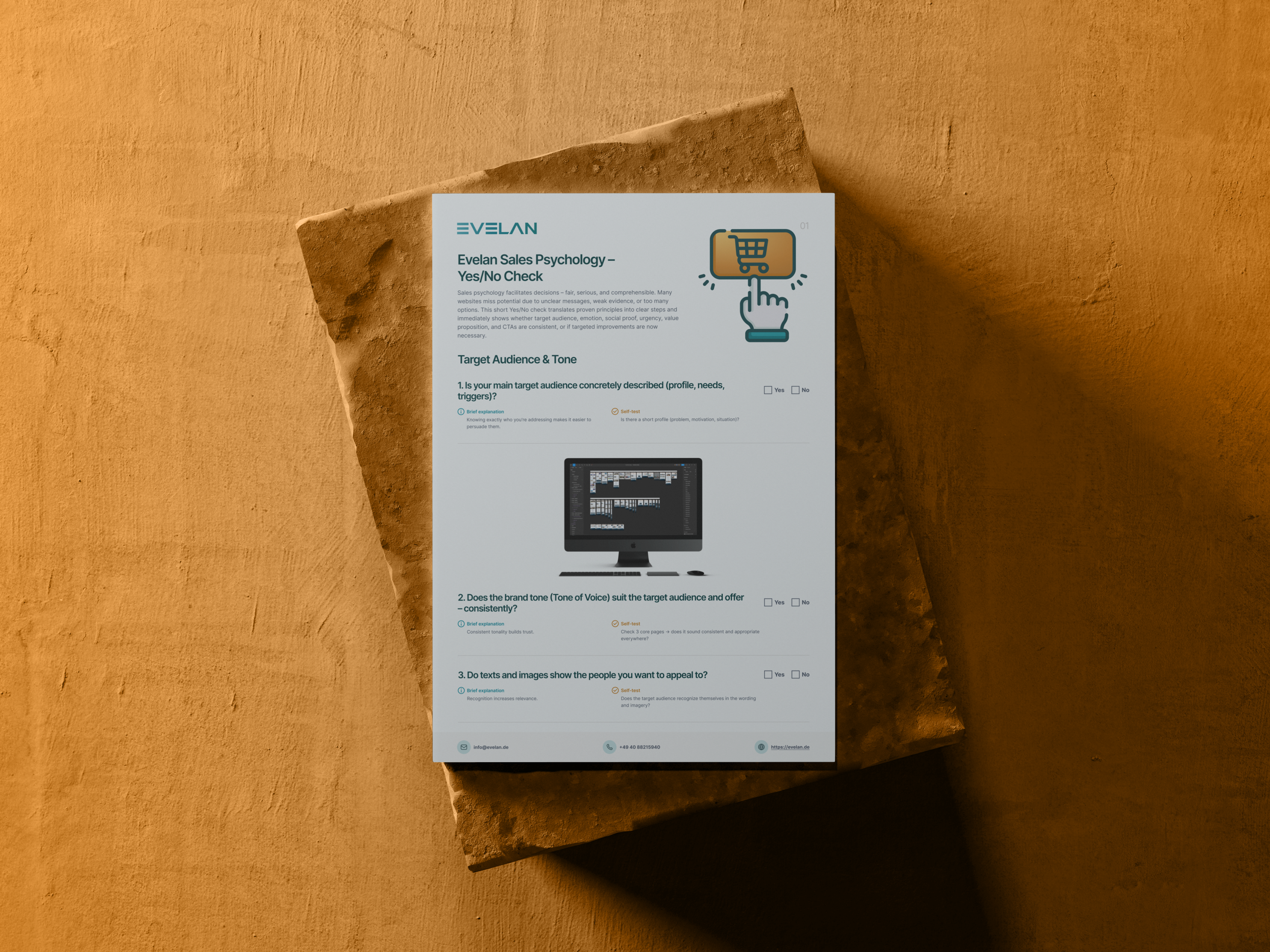
Sales Psychology Checklist
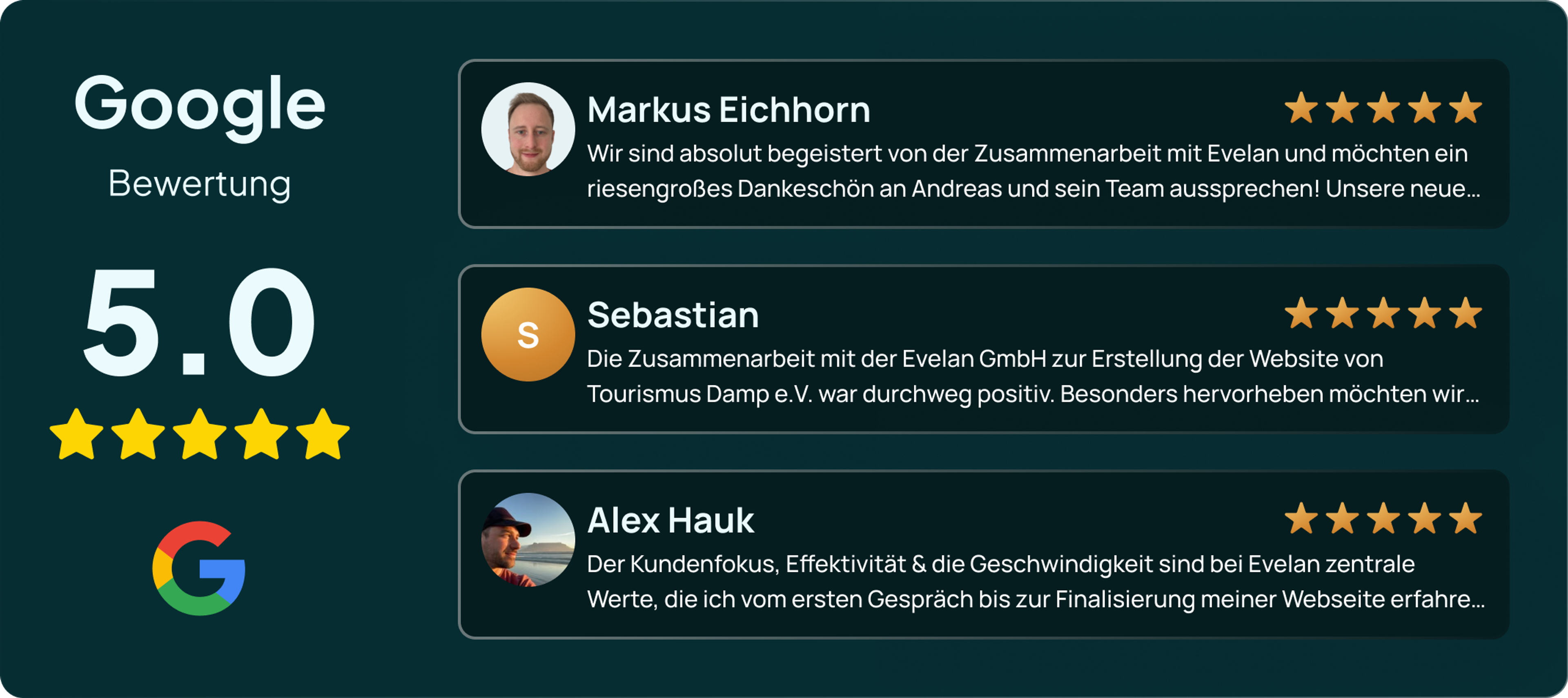
Buying decisions are rarely purely rational; they are driven by emotions, trust and the feeling of making the right choice. Many websites waste potential through unclear messages, weak evidence or too many options. Our free Sales Psychology Checklist shows you with 17 yes/no questions whether your site guides visitors fairly and transparently to a decision, from target audience and emotion through social proof and urgency to value proposition and CTAs. With a 5.0-star Google rating our clients confirm that Evelan designs websites that convince without pushing. Download the checklist and make your website more persuasive step by step.
What does the Sales Psychology Checklist cover?
17 checkpoints across 7 categories, a yes/no check for instant clarity on how persuasively your website guides visitors to a decision.
Target Audience & Tone
A specifically described target audience and a consistent brand tone in which the people addressed recognise themselves in copy and imagery.
Emotion & Story
Deliberately evoked feelings that ease decisions, and problems as well as solutions consistently described from your customers’ perspective.
Social Proof & Authority
Genuine testimonials close to the offer, visible logos, case studies and awards, plus claims backed by numbers and results.
Urgency & Scarcity
A plausible reason why acting now pays off, and deliberately few clear options instead of overwhelming visitors with too many choices.
Value Proposition & Benefit
A clear value proposition right at the top, visible benefits plus the consequence of not acting, and a USP in plain words without buzzwords.
CTAs & Path to Conversion
An immediately visible, unambiguous main CTA and a brief explanation of what happens after the click so no uncertainty remains.
Trust & Appearance
Legal basics such as imprint and privacy policy cleanly linked, plus a price signal that matches your offer’s positioning.
A more persuasive website in 3 steps
Download the checklist
Download the free PDF and get an overview of all 17 checkpoints across 7 categories.
Review your website
Go through your key pages and note where the message, evidence or next step is not yet convincing.
Boost persuasion
Implement the most important improvements yourself or let the experts at Evelan handle the execution.
How your persuasive website is created with Evelan
Persuasion does not come from tricks but from clarity, genuine evidence and an honest approach to the right people. That is exactly what we build on. From the initial analysis through psychologically informed design to ongoing optimisation, we shape every page to guide visitors fairly and transparently to a decision, entirely in-house in Germany. The result is a website that builds trust and accompanies visitors all the way to an enquiry without pressure.
1. Initial consultation
Free and without obligation, we clarify your target audience, your offer and the decisive buying motives. This reveals where your website does not yet convince and gives away trust.
2. Concept & psychology
We plan messages, evidence and the path to conversion along proven psychological principles. Value proposition, social proof and CTAs get their right place without feeling pushy.
3. Implementation
We implement the persuasive structure technically and visually, with clear CTAs, genuine evidence and a cohesive appearance. Everything is created 100 % in-house in Germany.
4. Ongoing support
After launch we observe how visitors respond, test variants and sharpen messages. This way your website’s persuasive power grows continuously.
Why sales psychology determines trust and conversions
People rarely decide purely rationally. They act from emotion, from trust and from the wish to make the right choice, and justify that decision with arguments only afterwards. Sales psychology leverages this insight, but in the best sense: it eases good decisions rather than talking people into something. Applied fairly and transparently, it helps visitors understand more quickly whether your offer suits them. Many websites waste potential through unclear messages, missing evidence or a flood of options that paralyses rather than guides. A structured checklist reveals where your site is not yet convincing, so that interest reliably turns into enquiries. Those who master these principles do not sell louder but clearer.
Addressing the right audience in the right tone
Persuasion starts with knowing exactly whom you are addressing. A brief profile of your main target audience with their problem, motivation and situation ensures that messages land instead of fizzling out. Equally important is a consistent brand tone that suits audience and offer and sounds the same across all key pages. When the people addressed recognise themselves in the phrasing and imagery, relevance rises noticeably. This recognition creates a feeling of being understood, and those who feel understood are more likely to give their trust. An inconsistent or mismatched tone, on the other hand, creates distance before the actual argument is even heard. A clear target audience also helps you leave out superfluous content and keep the page focused.
Emotion, story and social proof move people to decide
Good websites tell their story from the customer’s perspective. They start with the real concern, deliberately evoke feelings such as security or anticipation, and promise a tangible result rather than abstract services. This emotional layer is grounded by evidence, because nothing convinces as powerfully as other people’s experience. Genuine testimonials with name, role and date, visible logos, case studies and awards, plus concrete numbers remove doubt and provide reassurance. Storytelling and social proof work together: the story creates closeness, the proof creates credibility. Only this combination turns a nice text into a convincing argument that visitors actually follow. It is important that all evidence is real and verifiable, because fabricated references are quickly exposed and destroy the very trust they were meant to build.
Clear value proposition, gentle urgency and the right appearance
Right at the top, visitors decide within seconds whether to stay. A clear value proposition immediately answers what you offer, who it is for and what benefit it delivers, complemented by an understandable USP without buzzwords. Gentle urgency, for instance a plausible reason why acting now pays off, helps counter the habit of postponing, but should always remain honest. Equally important is not overwhelming visitors with options but offering one or two clear paths. Finally, appearance also contributes to perception: colour psychology and a coherent price signal ensure that your site underlines the value of your offer rather than contradicting it. This creates a cohesive overall picture in which message, visually and price all speak the same language.
From a convincing CTA to a trustworthy close
At the end of every persuasion stands a clear action. The main CTA should be immediately visible and unambiguously worded, for example Request a quote rather than a bland Submit. Equally important is removing the uncertainty before the click: a brief note on what happens after clicking, how the process works and how long it takes lowers the barrier significantly. Legal basics such as imprint and privacy policy belong visibly close to the contact section and CTA, because law and trust go hand in hand. Those who make this final step as simple and transparent as possible reliably turn interest into enquiries without ever needing to apply pressure. Every unnecessary click and every open question costs conversions at this point, which is why clarity pays off especially at the end.
Free Sales Psychology Checklist
Download the free checklist and review your website against 17 checkpoints across 7 categories. Or book a free initial consultation with our experts for persuasive websites.
Frequently asked questions about the Sales Psychology Checklist
Quick answers on usage, services, process and next steps.
The checklist examines 17 points across 7 categories: Target Audience & Tone, Emotion & Story, Social Proof & Authority, Urgency & Scarcity, Value Proposition & Benefit, CTAs & Path to Conversion, and Trust & Appearance. Each point is a simple yes/no check with a concrete self-test.
More checklists for your website
Each checklist covers a different area; together they form a complete website optimisation roadmap.