Imprint & data protection on websites
When creating a new website, many companies initially focus on design, brand image, and compelling content. An appealing look and clear user guidance are undoubtedly important. But regardless of how modern or high-quality a website is designed, two legal principles determine whether it can be operated successfully, trustworthily, and, above all, legally secure in the long term: a legally compliant imprint and a fully developed website privacy policy.
Both the legal notice and the privacy policy are required by law and apply to almost every website used for business purposes. The legal notice on the website must provide clear and complete information about who is behind the website, how the operator can be contacted, and what legally relevant information applies. The website privacy policy, on the other hand, provides transparent information about what personal data is collected, for what purpose, and what rights users have with regard to their data. If one of these components is missing or incomplete, this can have significant legal consequences.
Why professional implementation is essential
In practice, however, it is repeatedly evident that precisely these areas are underestimated. Many website operators rely on outdated templates, adopt texts from other projects, or fail to adapt legal content to the actual functions of their website. Mandatory information is often missing, new tools are integrated without updating the privacy policy, or the legal notice no longer complies with current legislation. Such omissions not only lead to formal deficiencies, but can quickly result in warnings, fines, or costly legal disputes.
Professional implementation of legal notices and data protection is therefore not an optional extra, but a central component of any secure website. Only when both areas are correct, complete, and up-to-date in terms of content can a website be created that meets both legal requirements and the legitimate security needs of users. A clearly worded, legally compliant imprint creates transparency and credibility, while a comprehensible and comprehensive privacy policy builds trust and shows that data protection is taken seriously.
As a website agency, we see every day how great the need for professional support in this area is. That's why our website packages always include an imprint and privacy policy website declaration as a matter of course. We ensure that all legally relevant information is correctly recorded, clearly formulated, and adapted to the individual functions of the respective website. Changes to tools, tracking technologies, or legal requirements are taken into account from the outset, so that the website remains legally compliant not only at launch, but also in the long term.
A secure website is characterized not only by technical stability and good performance, but also by legal clarity and transparency. Professionally implemented legal content is a decisive factor in building trust among visitors and business partners, while also protecting companies from unnecessary risks. Implementing legal notices and data protection correctly from the outset creates a stable foundation for sustainable online success.
Imprint & data protection as a trust advantage
A professionally implemented legal notice and a clearly structured data protection website are now much more than just mandatory information. They are a visible sign of professionalism, responsibility, and reliability. Users are increasingly paying attention to how transparently a website handles legal information and whether the handling of personal data is explained in a comprehensible manner. Especially in times of increasing data protection sensitivity, these factors often determine whether trust is established or not.
A clearly worded and well-structured privacy policy shows that data protection is not considered a tiresome obligation, but rather a natural part of a secure website. Users feel taken seriously when it is clear what data is being collected, for what purpose, and what rights they have. This transparency has a direct impact on the perception of the website and increases the willingness to make contact, fill out forms, or submit an inquiry.

A correctly implemented, legally compliant imprint also contributes significantly to credibility. It makes it clear who is behind the website, how the company can be contacted, and that legal requirements are taken seriously. If this clarity is missing or the imprint is incomplete, uncertainty quickly arises. No matter how technically and visually impressive a website may be, without a clear legal basis, its public image will suffer.
Legally compliant implementation of legal notices and data protection therefore not only protects website operators, but also offers measurable benefits. Greater trust leads to longer visits, lower bounce rates, and ultimately better conversion rates. At the same time, the risk of legal problems is significantly reduced, as typical warning traps are avoided. Overall, the website appears more professional, reliable, and strongly positioned.
Legally compliant legal notice
Many website operators still consider an imprint website to be a tedious formality. In fact, however, it is a legal obligation, and failure to comply can have significant legal consequences. In practice, incorrect or incomplete imprints are among the most common causes for warnings. These problems often arise because operators use general templates, overlook mandatory information, or do not know what information is specifically required for their company. A missing or incorrect imprint thus directly jeopardizes the legal security of the entire website.
What an imprint really has to do
A legally compliant imprint must provide clear, complete, and accurate information about the website operator. This includes details about the identity of the company or owner, a complete address that can be used for legal purposes, and easily accessible contact details. Depending on the type of company and its activities, additional mandatory information may be required, such as commercial register entries, VAT identification numbers, or the names of persons responsible for journalistic and editorial content. Certain professional groups, such as brokers, tradespeople, or doctors, are also subject to additional information requirements, which must be correctly reflected in the legal notice.
This is precisely where one of the biggest challenges lies. Many website operators do not know which information is mandatory in their specific case and which is not. Legal requirements vary depending on the industry, type of company, and type of website. An incomplete imprint is just as problematic as an incorrect one. Both can result in the website no longer being considered secure and becoming legally vulnerable.
Professional implementation for a secure website
This is precisely why we take care of creating and maintaining the legal notice in its entirety. We ensure that every website legal notice is clearly structured, complete, and tailored to the specific situation. In doing so, we not only take into account the current legal requirements, but also industry-specific features and individual requirements. The result is a legally compliant legal notice that minimizes the risk of warnings and at the same time conveys a professional impression.
A correctly implemented legal notice contributes significantly to a website being perceived as secure. It creates transparency, strengthens visitor confidence, and protects website operators from unnecessary legal risks. Implementing a professional legal notice from the outset lays an important foundation for a legally sound and reputable online presence.

Why professional data protection is essential for websites
Data protection is mandatory
A privacy policy is now required by law for almost every website. The GDPR applies whenever personal data is processed. This starts with simple contact forms and extends to server log files, newsletter subscriptions, analysis tools, tracking technologies, and embedded content from third-party providers. Many website operators underestimate how quickly data processing takes place in the legal sense and how extensive the information obligations actually are.
In practice, privacy policies are often incomplete, outdated, or not tailored to the actual functions of the website. Texts are often taken from other projects or generators are used without checking the content in detail. The result is a privacy policy that exists on paper but remains legally vulnerable. This means that the website loses its status as a secure website and exposes operators to unnecessary risks.
What a legally compliant data protection website must provide
A professional website privacy policy must be transparent, understandable, and provide complete information about what personal data is processed, for what purpose, and on what legal basis. In addition, users must be clearly informed about their rights, such as their right to access, delete, or object to the processing of their data. Information about storage duration, data transfer to third parties, and the tools used is also mandatory.
Data protection becomes particularly challenging when external services are integrated. Analysis and marketing tools, social media integrations, videos, maps, or fonts from third-party providers each require their own data protection assessments and corresponding information in the privacy policy. If this transparency is missing or incomplete, it can quickly lead to a GDPR violation. A secure website can therefore only be created if the privacy policy is precisely tailored to the technical implementation of the website and is updated regularly.
Professional implementation
This is precisely where our work comes in. We create each data protection website individually based on the actual functions, tools used, and technical structures. In doing so, we pay attention not only to formal completeness, but also to comprehensibility and clear language. Data protection should not be a deterrent, but rather inform and build trust.
A professionally implemented privacy policy strengthens the credibility of the website and shows visitors that their data is being handled responsibly. At the same time, it protects website operators from warnings, fines, and legal disputes. In combination with a legally compliant imprint, it forms the legal foundation of a secure website that meets both legal requirements and the expectations of modern users.
Why a professional agency makes such a big difference here
Imprint and data protection At first glance, websites often appear simple and quick to set up. In practice, however, they are among the most common legal weaknesses of websites. Small errors, incomplete information, or incorrectly integrated tools are enough to trigger warnings or fines. Precisely because legal requirements change regularly and technical requirements are becoming increasingly complex, professional implementation is crucial to remain on the safe side in the long term.
As a website agency, we do not view legal notices, data protection, and cookie issues in isolation, but rather as interrelated building blocks of a secure website. We ensure that all legally relevant information is complete, correct, and tailored to the respective website. This includes a legally compliant imprint that is automatically integrated and contains all the required mandatory information, as well as a custom-designed data protection website that is precisely tailored to the functions and tools used.
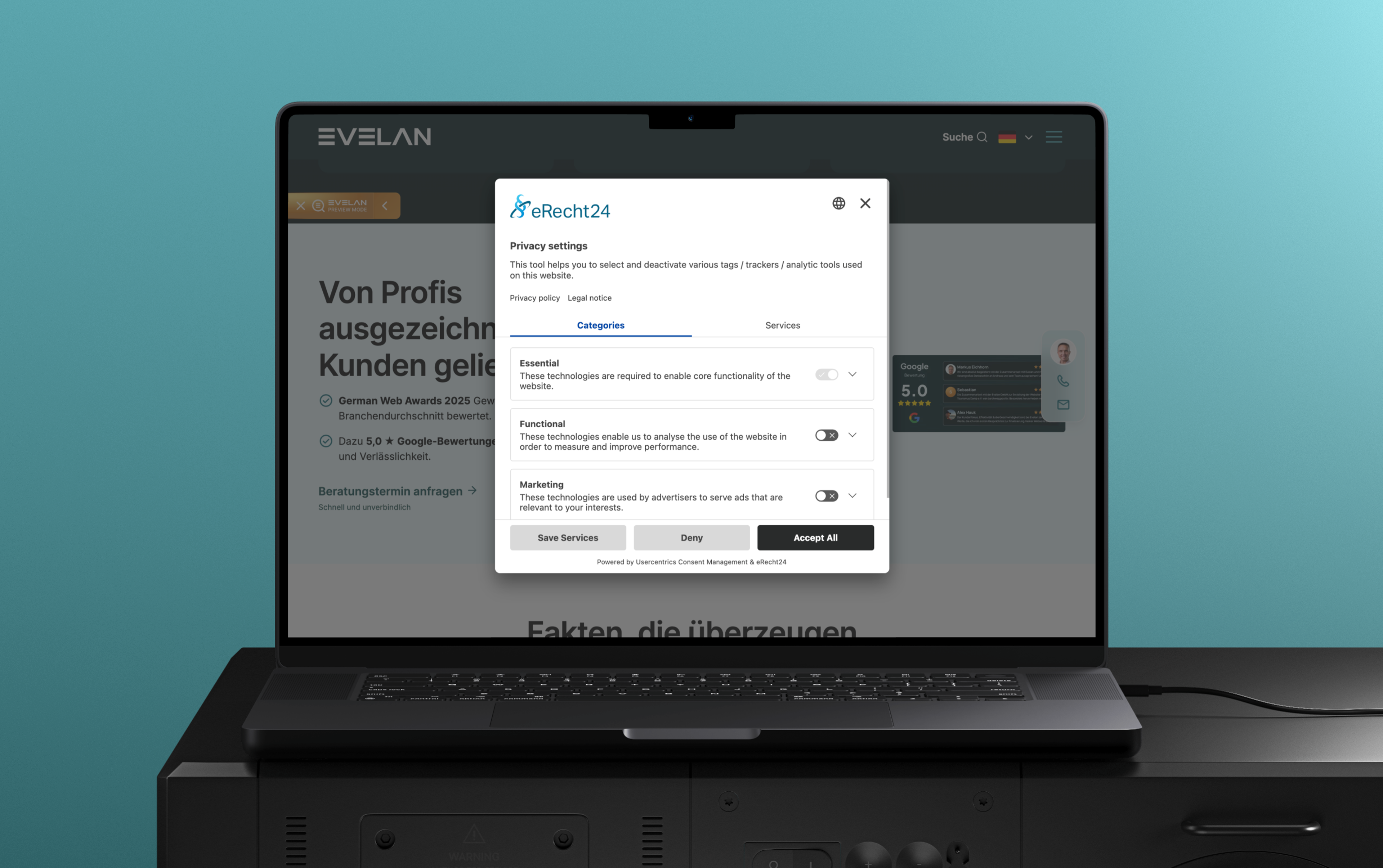
We place particular emphasis on technical implementation. We only integrate analysis and marketing tools, external content, and tracking technologies in a manner that complies with the GDPR. Cookie banners not only function visually, but also technically correctly, so that consent is effectively obtained and implemented. This ensures that the website remains legally compliant at all times and meets all the requirements of a modern, secure website.
For customers, this means one thing above all else: relief. They don't have to deal with legal details, technical intricacies, or ongoing adjustments. We take responsibility for ensuring that the website is and remains legally compliant.
Conclusion
A legally compliant imprint and a comprehensive data protection website are required by law and are also a key factor in building trust among website visitors. They create transparency, strengthen credibility, and form the legal basis for a secure website. If these elements are missing or incomplete, uncertainty can quickly arise—both for users and operators.
Those who implement legal notices, privacy policies, and cookie policies on their own run the risk of misjudging legal requirements or overlooking important details. Errors in these areas are among the most common causes of warnings and legal disputes. Professional implementation, on the other hand, ensures that all relevant components fit together neatly and remain legally compliant in the long term.
This includes a correctly integrated legal notice, a privacy policy tailored to the website, GDPR-compliant integration of all tools used, and a technically functional cookie banner. If these elements are considered from the outset and implemented professionally, the result is a website that is not only visually appealing but also legally sound.
This is how a modern website becomes a secure website that builds trust, minimizes legal risks, and functions professionally in the long term.