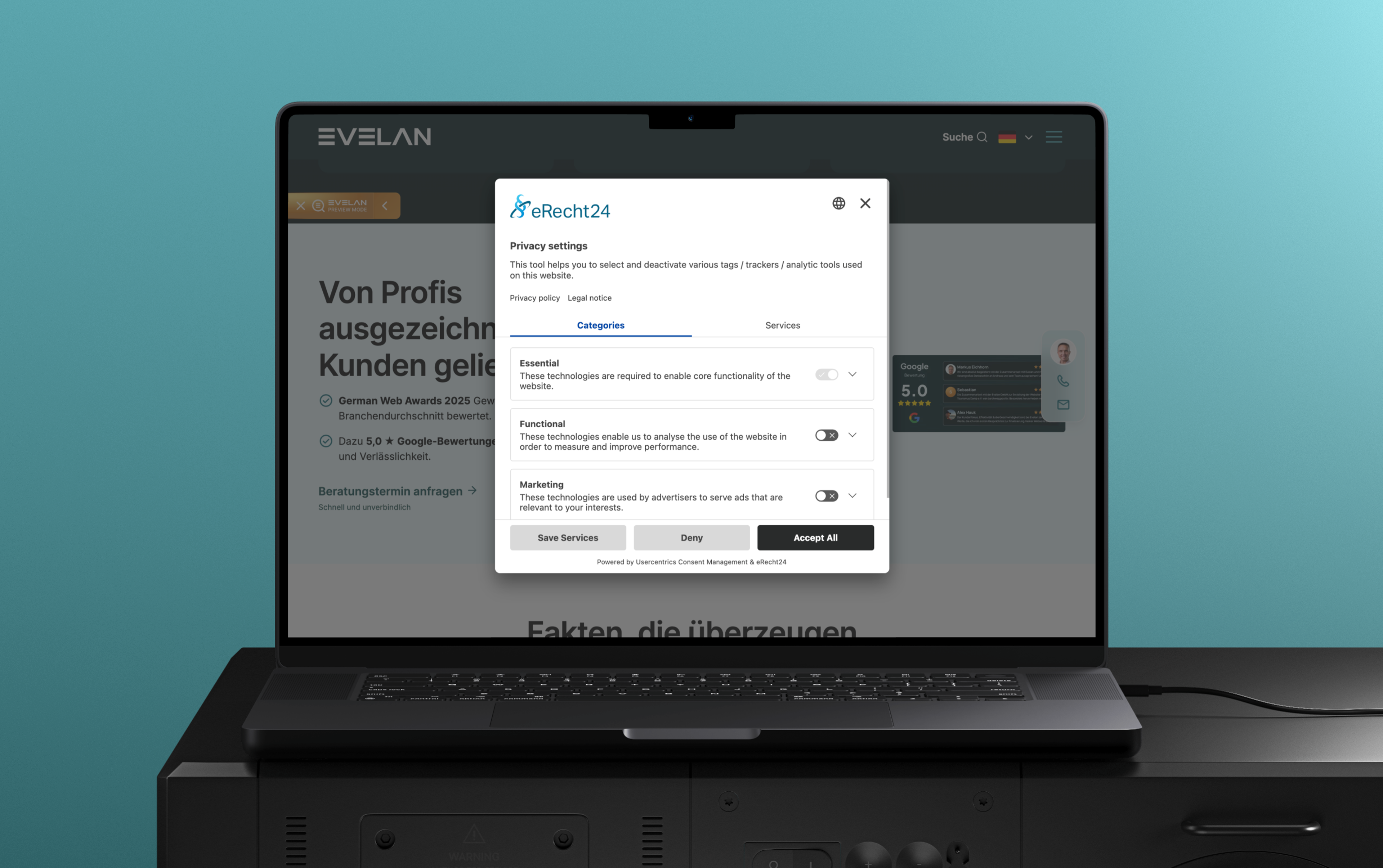
Cookie Consent Management
Anyone who operates a website today can no longer avoid the cookie banner requirement. Since the GDPR and the ePrivacy Directive came into force, it has been clearly regulated that cookies and similar technologies may not simply be used without consent. Nevertheless, many websites still adhere to outdated solutions and only display a short notice that informs the user but does not offer a real choice. Legally, this is no longer sufficient.
A cookie banner is merely the visible interface for visitors. However, what happens in the background is crucial. Only when consent is obtained correctly, implemented technically, and documented permanently can a website be considered legally compliant. This is exactly where cookie consent management comes in. It replaces the simple notice with a structured, traceable process that both protects the user and provides legal protection for the website operator. Without a professional system, the website remains vulnerable and only appears to meet the requirements of the cookie banner obligation.
A modern cookie consent manager is therefore essential if a website is to be not only visually appealing but also legally compliant. It ensures that cookies and tracking technologies only become active once effective consent has been obtained and prevents personal data from being processed unlawfully. This makes cookie consent management a key component of a secure website.

What cookie consent management actually means
A cookie consent management system, or CMP for short, is the technical foundation of a functioning cookie consent management system. It is a specialized tool that automates all processes related to obtaining, managing, and documenting consent. While the cookie banner is visible to the user, the CMP works in the background to ensure that the cookie banner requirement is implemented correctly not only visually, but also technically and legally.
Well-known solutions such as Usercentrics, Cookiebot, Borlabs Cookie, and OneTrust all pursue the same goal: they enable website operators to manage cookies and external services in compliance with the GDPR. A modern cookie consent manager regulates when and how the cookie banner is displayed, what choices are offered to users, and how their decisions are processed. At the same time, the system takes care of the technical blocking and subsequent activation of scripts, depending on whether consent has been given or not.
Another key component of a CMP is the complete documentation of all consents. Every consent or rejection is stored and can be verified if necessary. Without such a system, it is practically impossible today to operate a legally compliant website on a permanent basis. Manual solutions or simple banners without technical control do not meet either the legal requirements or the expectations of users. A CMP is therefore not an optional additional tool, but an indispensable component of a secure website.
Why is this so crucial?
The importance of cookie consent management stems from several closely interlinked factors. First and foremost are the legal requirements. The GDPR requires almost every website to actively obtain consent for non-essential cookies. In addition, ePrivacy regulations govern the use of tracking technologies and similar methods. Violations of these regulations can lead to costly warnings, fines, and damage to your image. A properly implemented cookie consent manager significantly reduces this risk and creates the basis for a legally compliant website.
In addition to the legal aspects, the technical perspective also plays a decisive role. External scripts from analytics, marketing, or third-party providers pose potential security risks if they are loaded in an uncontrolled manner. Professional cookie consent management ensures full control over these scripts and prevents data from being transferred unintentionally. At the same time, clean content control contributes to a more stable and higher-performing website structure, which has a positive effect on loading times and maintainability. This makes cookie consent management an important factor for a secure website in a technical sense.
Last but not least, good consent management also influences user trust and the user experience. Transparent information, clear choices, and respected data protection convey professionalism and reliability. Visitors feel taken seriously and retain control over their data. This trust has a long-term positive effect on the perception of the website and can even have measurable effects on conversion. Well-designed cookie consent management therefore not only complies with legal requirements, but also meets modern users' expectations for data protection, transparency, and security.
The most important tasks of cookie consent management

Obtaining consent
Obtaining effective consent is the starting point for any cookie consent management system and, at the same time, one of the most sensitive areas of data protection. The cookie banner requirement not only requires that users be informed about cookies, but also that they actively consent before personal data is processed. The timing is crucial here. Consent must be given before non-essential cookies or external services are loaded. Anything else is considered legally inadmissible.
In practice, this affects a wide range of common technologies. Analysis tools such as Google Analytics record usage behavior, marketing and tracking cookies create user profiles, and embedded content such as YouTube videos, Google Maps, or external fonts transfer data to third-party providers. None of these services may be activated without consent. A simple banner with a notice text does not meet these requirements, as it does not allow the user to make a genuine decision.
A professional cookie consent manager ensures that the consent process is transparent, understandable, and legally effective. Users must be able to clearly recognize which categories of cookies are used and what purpose they serve. At the same time, consent must be given voluntarily, without coercion or misleading design. Only when these conditions are met can consent be considered effective. This clean start is essential for operating a legally compliant website that is not built on shaky legal foundations.
Blocking cookies technically
As important as consent is on the surface, its technical implementation in the background is just as crucial. One of the most common mistakes is that websites display a cookie banner, but tracking scripts are already activated when the page is loaded. At this point, data protection has already been violated, even if the user later agrees or disagrees. This is precisely where it becomes clear whether it is a genuine solution or merely a symbolic measure.
Effective cookie consent management therefore relies on the consistent technical blocking of all unnecessary cookies and scripts. By default, this content must not be loaded. They are only released after an active opt-in. If the user refuses consent, tracking remains permanently disabled. This technical mechanism is the actual core of a secure website, as it ensures that data protection is not only claimed, but also technically enforced.
A modern cookie consent manager handles this control automatically and reliably. It ensures that external services are correctly categorized, that scripts are not triggered unintentionally, and that subsequent changes to user decisions are also taken into account. Without this technical control, the cookie banner requirement remains a mere facade and offers no real protection against GDPR violations.
Documenting consent
In addition to obtaining and implementing consent, documenting it plays a key role. The GDPR expressly requires website operators to be able to prove that valid consent has been obtained. It is therefore not enough for a user to have given their consent; this consent must also be verifiable. In the event of a dispute or an audit by a supervisory authority, the burden of proof lies with the operator.
A professional cookie consent manager ensures that consent is documented in an audit-proof manner. This includes storing the time of consent, the selected cookie categories, and the respective consent status. This information is stored anonymously or pseudonymously and makes it possible to track the decisions made by a user at any time. This documentation is indispensable, especially for returning visitors or when cookie settings are changed.
Without such consent logging, it is virtually impossible to defend your own website as a legally compliant website. The documentation not only provides legal protection, but also internal clarity. It makes data protection processes traceable and verifiable, making it an important component of a long-term, stable data protection strategy.
Enable revocation
Data protection does not end with the user's initial decision. A key principle of the GDPR is that consent can be revoked at any time. Users must be able to change their decision without having to search again or go through complicated procedures. Revoking consent must be just as easy as giving it.
Professional cookie consent management takes this aspect into account from the outset. As a rule, users are offered permanent access to cookie settings, for example via a clearly visible link in the footer of the website. There, they can adjust their selection at any time or revoke it completely. It is important that this change takes effect immediately and that the technical control of cookies responds accordingly. If consent is withdrawn, all affected cookies must be deactivated and, if necessary, deleted.
This transparency makes data protection comprehensible and trustworthy for users. At the same time, a properly implemented revocation process strengthens the legal protection of the website. A powerful cookie consent manager ensures that this process works reliably and that the website is permanently perceived as a secure website, not only from a technical point of view, but also from the user's perspective.
Common mistakes in cookie consent management
Many implementation problems arise not from intent, but from a lack of expertise, time pressure, or the use of outdated solutions. Especially when no professional cookie consent management is used, the implementation of cookie banners often remains superficial. Websites display a banner, but do not fully comply with legal and technical requirements. This creates a dangerous false sense of security: everything looks correct on the outside, but in reality, neither a legally compliant website nor a long-term secure website is guaranteed. Precisely because data protection requirements are constantly increasing, simple standard solutions are usually no longer sufficient today.
Lack of technical integration instead of a holistic solution
A common reason for errors is that cookie banners are viewed in isolation. Often, only a visible banner is installed without linking it cleanly to tracking tools, marketing scripts, or external services. In such cases, cookies or third-party scripts are sometimes activated as soon as the website is loaded, even though consent has not yet been given. Without proper blocking and control in the background, data protection violations automatically occur, even if the banner appears to be visually correct. A fully integrated cookie consent manager, on the other hand, ensures that all relevant services are controlled centrally, thus supporting the creation of a truly secure website.
Focus on design rather than legal requirements
Many websites attach great importance to ensuring that the banner is visually discreet or has as little influence as possible on user guidance. In doing so, legal requirements are often underestimated or deliberately simplified. For example, the reject function is hidden, choices are reduced, or consent is influenced by design tricks. This practice can lead to the cookie banner requirement appearing to be formally fulfilled, but in reality, no effective consent has been given. However, for a website to be legally compliant, it is crucial that users are able to make a genuine, voluntary, and transparent decision.
Lack of maintenance and lack of data protection expertise
Websites are constantly evolving. New tools, plugins, tracking services, and marketing solutions are integrated without adapting the existing consent system. This is precisely where new data protection gaps often arise unnoticed. Without regular review and maintenance, even a cookie consent manager that was originally set up correctly can become incomplete over time. In addition, many companies lack specialized data protection expertise, which means that risks are often identified too late. A legally compliant website and a permanently secure website therefore require not only a one-time setup, but also continuous maintenance and adaptation to new technical and legal requirements.
Common mistakes with cookie banners
❌ Banner only displays a notice, but no real choice ❌ Cookies are already running before consent is given ❌ "Reject" is hidden or difficult to find ❌ No storage/documentation of consent ❌ No revocation possible
These errors mean that the website is not GDPR-compliant, even if a banner is displayed.
Conclusion
Errors in cookie consent management usually arise not from missing banners, but from incomplete implementation in detail. The cookie banner requirement demands much more than visible information for users. The decisive factor is the interplay of technology, law, and continuous maintenance. Without a professionally integrated cookie consent manager, implementation often remains incomplete, which means that neither a legally compliant website nor a permanently secure website can be guaranteed.
Companies should therefore not view cookie consent management as a one-time task, but rather as an integral part of their website strategy. Only when consent is obtained correctly, implemented technically, documented, and reviewed regularly can a sustainable data protection structure be created. Those who rely on professional solutions early on reduce legal risks, strengthen user trust, and lay the foundation for a stable and secure website in the long term.