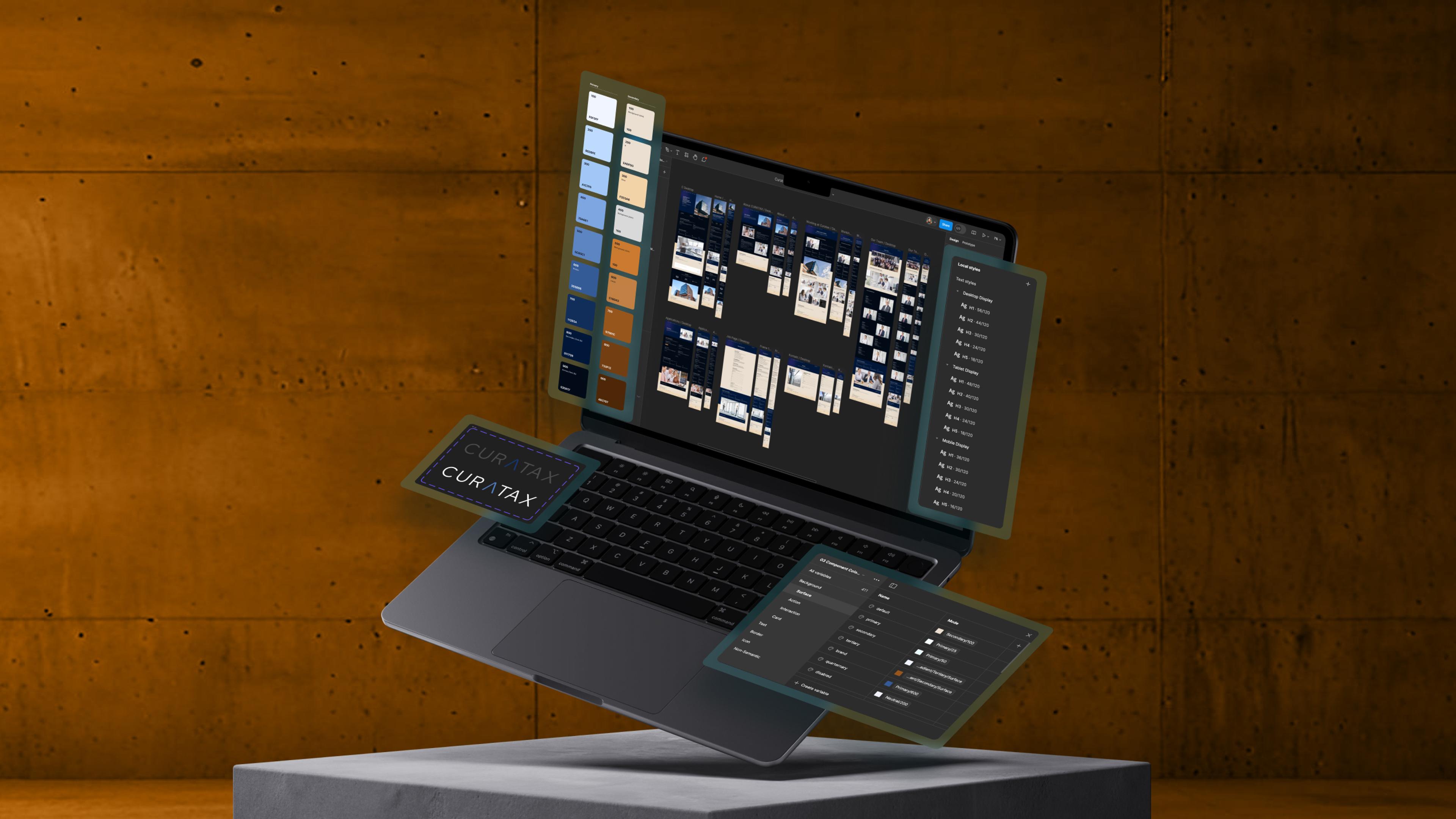
Web design with character
Custom web design is far more than just a visual gimmick. It forms the foundation for a strong brand identity, provides a seamless user experience and delivers measurable business results. While ready-made web design templates promise quick fixes, they can hardly offer the uniqueness and depth that a customized solution provides. In this article, you will learn why custom web design offers unbeatable advantages over standard templates and how you can use them specifically for your online success.
Strengthening brand identity through individual web design
A consistent brand presence is the key to standing out in the crowded online market. Standard templates may offer quick design options, but they are rarely able to reflect your brand values, your story and your target group in a differentiated way.
Corporate Identity im Fokus
An individual web design anchors your corporate colors and preferred fonts precisely in the layout, integrates logos, icons and images into a coherent overall picture and allows target group-specific copywriting in which tonality, headlines and texts convey the message just as clearly as the visuals.
Example: A sustainable fashion start-up relies on earthy colors and hand-drawn illustrations. Only an individually created layout conveys precisely this natural flair and clearly differentiates itself from generic templates.
Optimizing the user experience with professional web design
The success of your website depends largely on how quickly and intuitively visitors can find the information they are looking for. Professional web design focuses on usability and thus ensures satisfied users, longer dwell times and lower bounce rates.
User journey and information architecture
A clear information architecture ensures that visitors get exactly where they want to go without any detours. Instead of general menus, we develop individual navigation systems: The most important areas appear as clearly visible buttons, sub-items are hidden behind clearly labeled headings, and discreet icons inspire confidence and orientation.
At the same time, visual hierarchies improve readability: larger headings organize thematic blocks, bold key statements direct the eye and the reading flow is maintained. Each page is thus created as a logical part of a whole and can be used just as intuitively on a smartphone as on a large desktop screen thanks to responsive web design.
Loading times and performance optimization
Short loading times are crucial for satisfaction and search engine rankings. We reduce superfluous code by replacing heavy CSS and JavaScript frameworks with lean in-house solutions. This means that each line of code only loads what is really needed.
We optimize images and media automatically: modern formats and compression reduce file sizes, while lazy loading only loads the elements that are currently visible. Together, this package usually keeps your pages under two seconds loading time - a noticeable gain for visitors and conversion.
Better findability through SEO-optimized web design
Google and other search engines reward websites that function technically flawlessly and offer relevant content. Having web design created with a focus on SEO means aligning every design decision with search engine friendliness.
Technical on-page factors
Clean HTML code forms the backbone of every website. Structured markup with meaningful heading tags (H1 to H6) makes content immediately recognizable for both search engines and visitors. In addition, short, descriptive URLs instead of cryptic parameters such as "?p=123" contain relevant words in the address: meine-seite.de/webdesign-tipps. This helps search engines and users alike to categorize the content immediately.
Content strategy and keyword integration
The basis of every successful content strategy is comprehensive keyword research. This involves identifying relevant long-tail keywords that target both user needs and lower competitive pressure.
A content hub links thematically related articles in a cluster model. This internal networking distributes link equity specifically to central landing pages and increases the thematic authority of the entire domain.
Regular performance analyses in tools such as Google Analytics and the Search Console monitor visibility, click rates and bounce rates. Findings from these evaluations are incorporated into the ongoing optimization of content and keywords in order to continuously increase effectiveness.
Scalability and flexibility in website design
Your company is growing, requirements are changing - and your website needs to keep pace. With a customized web design, you are able to integrate new features and modules without much additional effort.
Modular design and component library
Modular UI components that are needed again and again - such as buttons, cards or forms - ensure consistency and shorten development times, while a headless approach separates the frontend and backend so that both can be developed independently. Design tokens define central variables for colors, spacing and animations that can be used at any point in the project to ensure a uniform appearance.
Simple expansion options
With a plugin architecture, you can easily add your own functions to the website without changing the basic system. External programs such as customer management or merchandise management systems can be connected directly to the website via API connections. This allows you to maintain all content in one place, which then appears automatically on the website.
Competitive advantage through individual design instead of web design templates
In a market where countless websites are similar to the point of being confusingly similar, a professional web design acts like a beacon: it creates trust and is remembered. Instead of relying on interchangeable templates, present a truly unique design that makes your brand unmistakable. This is complemented by interactive details - from customized animations to micro-interactions - and effective storytelling that guides visitors emotionally through your content.
Higher conversion rates through targeted call-to-action in individual web design
Design and usability have a direct influence on the conversion rate. With professional web design, you can place, design and test CTAs in such a way that they achieve maximum impact.
Customer analysis
CTA variants are specifically tested: Different colors, positions on the page and texts of the buttons help to find out which combination generates the most clicks and sales.
Finally, the analysis of the conversion funnels shows how users are guided step by step from the first page to the conclusion of the purchase. Based on this user journey, you can see exactly where interested parties drop out and make targeted improvements to increase the completion rate.
Best Practices für CTA-Design
A convincing call to action thrives on a high-contrast color choice that immediately sets the button apart from the rest of the page design and directs the eye directly to the next destination. Short, concise texts with active verbs such as "Save now" or "Find out more" arouse curiosity and make it unmistakably clear what happens next. Placement also determines success: a CTA above the fold ensures that it is visible at the first glance at the page, while another button at the end of an article picks up those who have read the content to the end. Finally, a sticky menu keeps the call to action in view at all times, even when scrolling - turning every opportunity into a potential conversion.
Long-term cost savings through in-house web design
Tip: Individual design pays off
People often think that individual web design is too expensive and only pays off after many years - but this is precisely where the greatest savings potential lies. A customized system with reusable building blocks and uniform design rules prevents constant license purchases and reduces the effort required for subsequent adaptations. This means that new functions or pages can be implemented internally without having to book expensive agency hours, and the follow-up costs for maintenance and extensions remain permanently low.
Reduced follow-up costs
Clean code reduces technical debt and ensures that subsequent changes can be implemented with minimal effort.
Clear documentation and style guides provide internal and external developers with unambiguous guidelines and prevent misunderstandings within the team.
Automated regression tests check immediately after each adjustment whether existing functions continue to run smoothly, thus saving time-consuming manual checks.
Sustainable further development
Thanks to detailed documentation and clearly structured onboarding processes, new team members find their way around in no time at all and can work productively. This forms the basis for long-term partnerships: an agency that already knows its own system can not only implement projects faster, but also work more cost-effectively. At the same time, a scalable infrastructure ensures that hosting costs always remain within reasonable limits because only the resources that are actually needed are used.
Conclusion
Individual web design is much more than just a visual decision: it strengthens your brand identity, optimizes the user experience, improves SEO performance and delivers demonstrably higher conversion rates. In the long term, you benefit from lower follow-up costs and a scalable infrastructure. If you take professional web design seriously, you are investing in a strong foundation for sustainable online success. Decide today to see your website as unique - and not as a standard off-the-shelf product.