The legally compliant website
A legally compliant website is not created by a single measure or tool. It is the result of a holistic interplay of data protection, technical security, mandatory legal information, ongoing monitoring, and professional implementation. This is precisely where the content of your website comes in. This pillar topic brings together all relevant aspects, organizes them in a meaningful way, and clearly shows how individual measures can be combined to create a secure website that will stand the test of time.
In practice, many website operators only deal with individual areas. The focus is often on the GDPR, the cookie banner, or the legal notice. These topics are undoubtedly important, but when viewed in isolation, they fall short. Legal certainty on the web does not work according to a modular principle. A privacy policy alone does not protect against legal risks if tracking scripts are incorrectly integrated. A correct imprint is not enough if there are technical security gaps or external tools transfer data in an uncontrolled manner. Only when all areas are interlinked can a legally secure website be created that is both legally stable and technically protected.
Technical security is a central component of this overall concept. Outdated systems, insecure plugins, or missing protection mechanisms not only pose a technical risk, but can also have legal consequences. Data protection and IT security are closely linked. This is exactly where a website security check comes in. It helps to identify vulnerabilities, close security gaps, and put the website on a solid foundation. Without regular checks, even a well-planned website remains vulnerable to problems that can jeopardize trust and legal certainty.
Website support
At the same time, ongoing support plays a crucial role. Legal requirements change, new tools are integrated, and functions are expanded. A website that is legally compliant today may no longer be so tomorrow if adjustments are not made. A secure website is therefore not a static state, but an ongoing process. This is precisely why working with a professional website agency is becoming increasingly important for many companies. It ensures that legal, technical, and security-related aspects are not considered in isolation, but are continuously coordinated with each other.
A legally compliant website is therefore more than just a legal requirement. It is a sign of trust for users, a protective shield for companies, and a prerequisite for sustainable online success. Those who take a holistic approach to security, data protection, and technology will create a website that not only looks good but also functions reliably in the long term—legally compliant, technically stable, and trustworthy for all visitors.
What constitutes a legally compliant website today
The term "legally compliant website" is often underestimated or misinterpreted. It encompasses much more than just a correct imprint or privacy policy. A website is only considered legally compliant if legal, technical, and organizational requirements are met simultaneously.
These include, among others:
- GDPR-compliant handling of personal data
- Legally compliant cookie consent management
- Technically secure server and website structures
- transparent user information
- ongoing monitoring and maintenance
Data protection as the foundation of every secure website
Data protection forms the legal core of every modern secure website. Even simple and seemingly harmless functions make a website GDPR-relevant. Contact forms, server log files, analysis tools, embedded videos, or map material from third-party providers lead to the processing of personal data. This is precisely where the General Data Protection Regulation comes into play, setting clear requirements for transparency, legality, and control of data processing.
Many website operators underestimate how quickly data protection obligations arise. You don't need complex user accounts or extensive tracking systems to fall within the scope of the GDPR. Even the use of an analysis tool or an external font can be enough. That's why our own content within this pillar focuses specifically on the question of what data protection actually means on websites, what obligations exist, and how these can be implemented correctly. Because without proper data protection, there can be no legally compliant website.

Data protection is more than just a text
In the context of a legally compliant website, data protection cannot be reduced to a mere privacy policy. Although a transparent and comprehensive privacy policy is required by law and is the first visible point of contact for users with the topic of data protection, it is only the surface of a much more comprehensive system. Actual data protection takes place in the background and involves technical, organizational, and procedural measures that ensure that personal data is only processed lawfully.
At the same time, the privacy policy remains indispensable. It fulfills a central information obligation and creates transparency about what data is collected, for what purpose, and what rights users have. Without a correctly worded privacy policy, the legal basis for this transparency is lacking, even if the technical implementation is done properly. Data protection therefore only works in combination with understandable information and correct technical implementation.
The situation is similar with the legal notice. Even if it has no direct influence on data processing, a complete and correct legal notice is a fundamental component of any legally compliant website. It clarifies who is responsible for the offering and creates legal attribution and reliability. Without a legal notice, there is no formal basis on which data protection, consent, and responsibilities can be classified at all. The privacy policy and legal notice thus form the legal framework within which data protection processes can be effective in the first place.
Key data protection issues therefore concern not only texts, but above all processes. The decisive factors are when and where personal data is collected, which services or scripts already transfer data in the background, and on what legal basis this processing takes place. Equally important is how consent is obtained, technically implemented, and documented. If data is already transferred when the page is accessed, even though no consent has been given, the legal basis is immediately lost—regardless of how carefully the privacy policy or legal notice is worded.
A secure website is therefore characterized by the fact that data protection is not only explained, but also consistently enforced technically. At the same time, all legally required information must be provided correctly, up-to-date, and transparently. Processes must be traceable, controllable, and verifiable at all times. Only the combination of technical implementation, clear processes, a complete privacy policy, and a legally compliant imprint creates a data protection concept that is legally robust and will stand up in an emergency.
Why the cookie banner is much more than just a notice
A cookie banner is not purely a design or convenience feature, but a legally highly relevant tool. It forms the visible interface between the website, the user, and the law. In many cases, however, cookie banners are underestimated or used incorrectly, for example as a mere notice without any real options. This is precisely where significant legal risks arise. A simple notice banner that merely informs users about the use of cookies does not meet legal requirements and cannot guarantee the legal security of a website.
The related blog articles on this topic explain in detail why such solutions are insufficient and why professional cookie consent management is indispensable today. Legal requirements from the GDPR and ePrivacy Directive require active, informed consent before non-essential cookies or tracking technologies may be used. The cookie banner plays a central role in obtaining this consent in a transparent and effective manner.
Consent Management
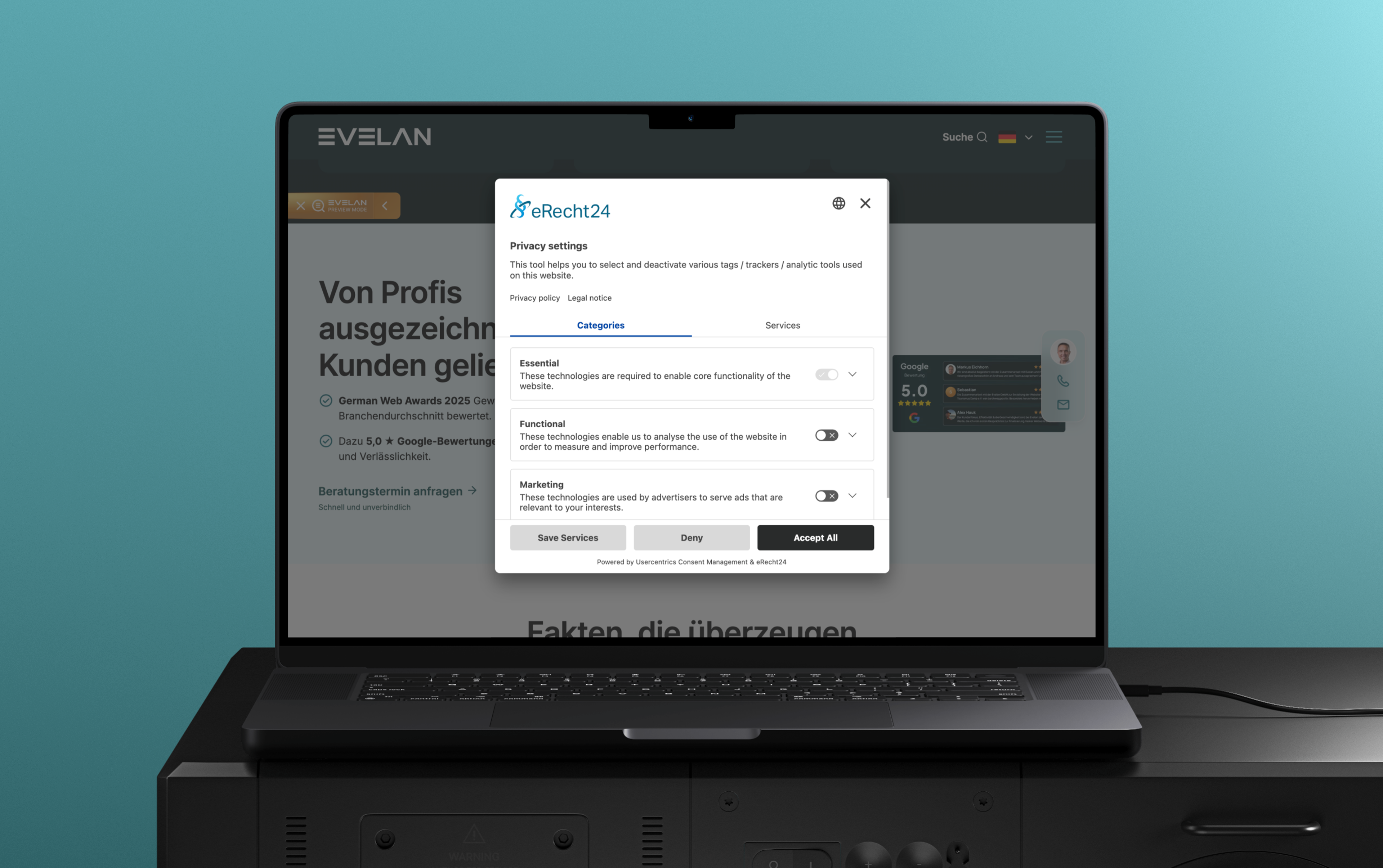
Cookie banners and consent management play a key role in ensuring that a website is legally compliant. They combine three areas that are often considered separately: data protection, technical implementation, and user interaction. Data protection defines the legal requirements, the technology implements these requirements in the background, and the cookie banner establishes direct interaction with the user.
A functioning consent management system ensures that cookies, tracking scripts, and external services are only loaded once valid consent has been given. At the same time, users must have genuine choices, i.e., they must be able to not only consent, but also refuse or make differentiated settings. These decisions must not only be requested, but also technically implemented. Only then can data protection be effective and traceable.
Furthermore, documenting consent is a central component of consent management. Acceptances and rejections must be stored and, in case of doubt, verifiable. Without this traceability, there is no legal evidence, which is required in the event of an audit or complaint. Cookie banners and consent management are therefore not only an entry point for users, but also a fundamental component of the entire data protection architecture.
Typical weak point
In practice, consent management repeatedly proves to be one of the most common weaknesses of websites. Even technically well-designed and visually professional websites often fail due to incorrect cookie implementation. Cookies are set too early, scripts load as soon as the page is accessed, or refusals are not technically handled correctly. Such errors make a website legally vulnerable despite good technology.
This is precisely why this area plays a central role in every website security check. Cookie banners and consent management are specifically checked, as they represent a direct link between legal requirements and technical implementation. If this component is missing or inadequately implemented, even an otherwise stable website can lose its status as a legally compliant website.
When a website agency becomes crucial

Growing complexity
The larger and more functional a website becomes, the more complex the legal, technical, and security requirements become. What is still manageable for small projects quickly develops into a web of legal obligations, technical dependencies, and security-related risks as content, tools, and user interactions increase. This is precisely where a website agency becomes a decisive factor, not primarily as a designer, but as a strategic partner for a legally compliant website.
With every expansion of a website, the requirements increase. New analysis or marketing tools, additional forms, external content, or interfaces to third-party systems raise new data protection issues. At the same time, technical systems must be kept up to date, security gaps closed, and legal texts adapted. Without comprehensive control, there is a risk that individual measures will be implemented in isolation and the website as a whole will lose stability.
The role of the website agency
A professional website agency keeps track of all relevant legal requirements and ensures that these remain integrated with the technical implementation. It ensures that legal changes, new court rulings, or technical developments do not go unnoticed, but are incorporated into the website in a timely manner. This includes regular updates, maintenance, and adjustments, as well as the correct integration of new functions.
A key component of this work is regular website security checks. These help to identify vulnerabilities at an early stage, before they become legal or technical problems. This involves not only classic security gaps, but also data protection risks, incorrect cookie implementations, and uncontrolled script loading. This continuous monitoring ensures that the website remains secure at all times, even when requirements and conditions change.
In addition, a website agency actively monitors the website. Any anomalies, technical errors, or security-related incidents can be detected early on and resolved in a structured manner. In serious cases, quick and coordinated action is crucial to limit damage and avoid legal consequences.
Why legal certainty must not be a side project
This aspect is particularly crucial for companies. Today, a website is a central communication and sales channel and therefore also a legal risk if it is not professionally managed. Legal certainty must therefore not be a side project that is reviewed occasionally, but must be guaranteed on an ongoing basis. This is the only way to ensure that the website not only functions technically, but also remains legally resilient.
In this context, a website agency takes on the role of a long-term partner. It ensures that content, technology, and security are not viewed separately, but function as an interconnected system. This results in a legally compliant website that grows with the company, minimizes risks, and builds trust among users and business partners.
Conclusion
A legally compliant website does not come about by chance, nor is it the result of implementing individual measures. It is the result of a holistic system in which data protection, technical security, clear legal foundations, defined processes, and continuous monitoring are interlinked. If only one area is considered, gaps will inevitably remain. It is precisely these gaps that later lead to legal risks, security problems, or a loss of trust.
Data protection, website security, legal notices, cookie consent, and technical safeguards are not isolated issues. They influence each other and must be coordinated. A privacy policy is ineffective if data is processed incorrectly from a technical standpoint. A cookie banner does not fulfill its function if consent is not implemented correctly. And even a technically stable website loses reliability if legal requirements are not consistently met.
This is where the role of a website agency becomes clear. It ensures that the entire system is not only set up correctly once, but also functions permanently. Legal changes, technical developments, and new requirements are continuously taken into account without individual components becoming unbalanced. This ensures that the website not only remains formally correct, but also develops into a permanently secure website.