Data Protection Checklist
How a website handles visitor data determines trust and legal safety at the same time. Many sites collect more data than necessary or explain too vaguely what happens with it, risking warnings and fines. Our free Data Protection Checklist guides you through transparency, consent, third-party services and logging with 14 yes/no questions, clearly and immediately actionable. As an eRecht24 agency partner for legally compliant websites, Evelan builds sites that incorporate data protection cleanly from the start. Download the checklist and make your website more legally secure step by step.

What does the Data Protection Checklist cover?
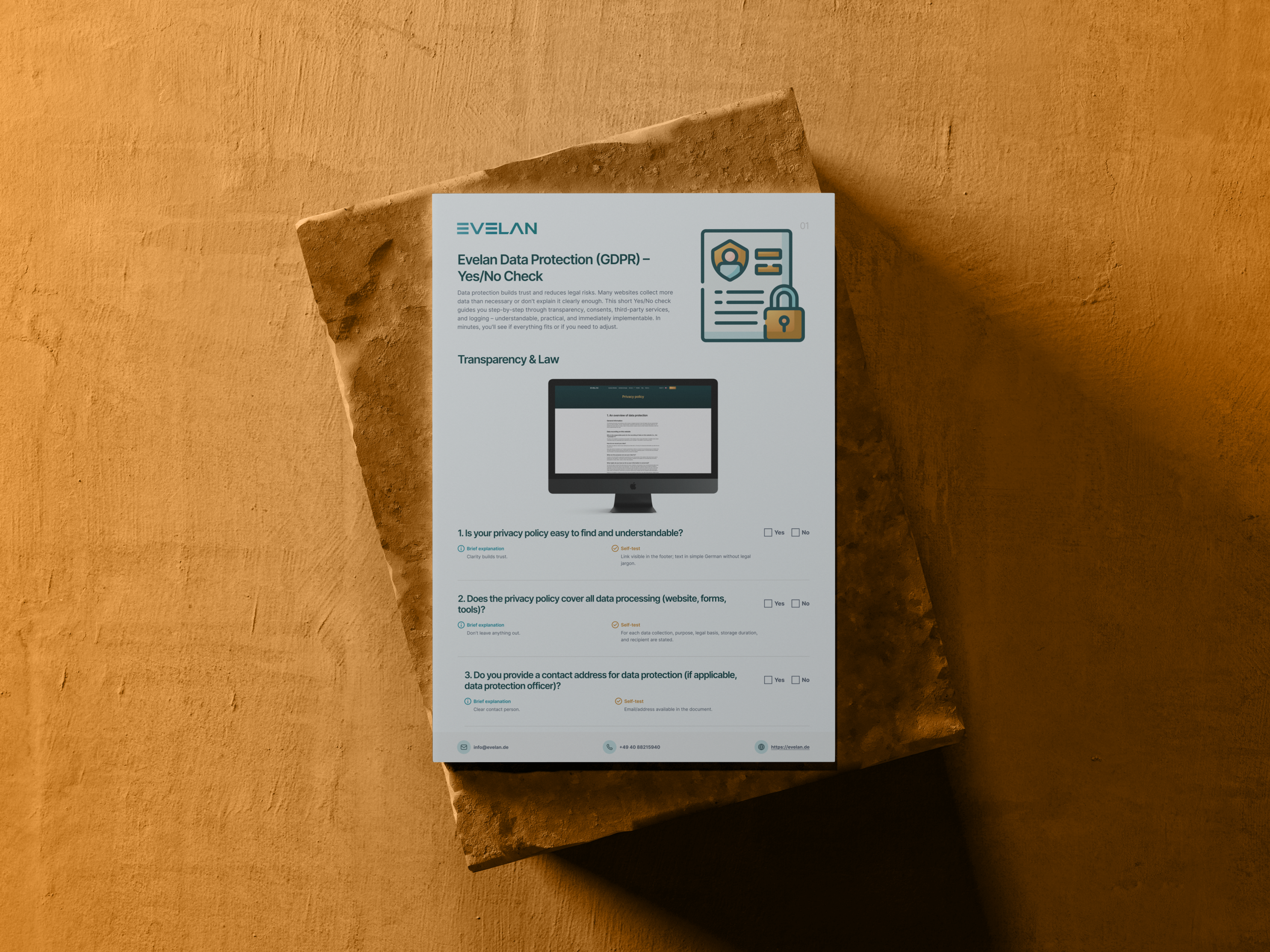
14 checkpoints across 6 categories, a yes/no check for instant clarity on whether your website is properly set up from a data protection perspective.
Transparency & Law
An easy-to-find, clearly written privacy policy covering all data processing, plus a clear contact address for data protection enquiries.
Cookies & Consent
A cookie banner before non-essential cookies, a genuine choice between reject, accept and configure, and permanently respected settings.
Forms & Data Minimisation
Forms that only request truly necessary data, and proper consent with double opt-in where required.
Third Parties & Contracts
Data processing agreements with all service providers handling personal data, and regular reviews of their data protection practices.
Analytics & Logs
Analytics tools that only load after consent and with IP anonymisation, plus anonymised and time-limited server log files.
Organisation & Maintenance
A privacy policy kept current with version information when changes occur, and clear retention and deletion periods for personal data.
A legally secure website in 3 steps
Download the checklist
Download the free PDF and get an overview of all 14 checkpoints across 6 categories.
Review your website
Work through the points and note where transparency, consent or clear deadlines are still lacking.
Close the gaps
Implement the technical adjustments yourself or let the experts at Evelan handle the clean execution.
How your data-protection-compliant website is created with Evelan
Data protection cannot be bolted on afterwards; it belongs in the technical implementation from the very beginning. That is exactly how we work. From the first conversation through the concept to ongoing support, we consider transparency, consent and data minimisation from day one, entirely in-house in Germany. The result is a website that protects the trust of your visitors and significantly reduces legal risks.
1. Initial consultation
Free and without obligation, we get an overview of your data processing, the tools in use and the current status. This reveals where your website should still adjust its data protection.
2. Concept & consent
We plan clean consent management, data-minimising forms and the correct integration of analytics tools. Every data collection receives a clear purpose and an appropriate legal basis.
3. Technical implementation
We implement cookie banners, IP anonymisation and anonymised log files with clean code. Everything is created 100 % in-house in Germany and thoroughly tested.
4. Ongoing support
After launch we keep your data protection settings current, review newly added tools and document changes. This keeps your website permanently transparent and traceable.

Why data protection builds trust and reduces risk
Data protection is often perceived as a tedious obligation, yet in reality it is a powerful trust factor. Those who explain openly and clearly which data are collected for which purpose signal respect for their visitors. Conversely, intrusive tracking, opaque cookie banners or a missing privacy policy quickly deter and can prove expensive, because GDPR violations lead to warnings and substantial fines. Good data protection does not mean giving up analytics and convenience but implementing both cleanly and transparently. A structured checklist helps identify the typical weaknesses in transparency, consent and data minimisation before they become a problem. It is important to note that the following points offer practical guidance and do not replace legal advice. Those who master these fundamentals turn an apparent obligation into a genuine advantage in trust and competitiveness.
Transparency is the foundation
It all begins with a privacy policy that is easy to find and written in plain language instead of impenetrable legal jargon. It should be accessible via a visible link in the footer and genuinely cover all data processing, from the website itself through forms to the tools in use. For every data collection, purpose, legal basis, retention period and recipients should be stated. Equally important is a clear point of contact, meaning an email address or postal address for data protection enquiries and, where applicable, the details of a data protection officer. This transparency gives visitors the feeling that their data are in responsible hands, and is at the same time a legal prerequisite that no reputable website should lack. A clearly written policy also noticeably reduces the number of enquiries and complaints.
Cookies, consent and data minimisation
Before non-essential cookies are set, a cookie notice is required, and on the first visit only technically necessary cookies may be active. Genuine freedom of choice is decisive: users must be able to reject just as easily as they accept, should be able to configure individual categories, and their decisions must be respected permanently, even on a return visit the next day. The same principle applies to forms: only collect the data you truly need and obtain clear consent where necessary, for example via double opt-in for a newsletter. Data minimisation is not only a legal requirement but also lowers the barrier for visitors to fill in a form at all. A cleanly implemented consent banner also looks professional and disrupts the user experience as little as possible.
Third parties, contracts and logs
As soon as external services process personal data, be it analytics tools, hosting or newsletter systems, you need a data processing agreement with those providers. A complete list of all tools in use and an annual check of processing location, sub-processors and changes ensure you maintain oversight. Analytics tools should only load after explicit consent and anonymise IP addresses so that no tracking occurs without permission. Server log files should likewise be anonymised and stored only as long as genuinely necessary. This way you do not shift responsibility out of control but regulate collaboration with service providers cleanly and traceably. Providers outside the EU deserve a particularly close look at the location of data processing.
Data protection is an ongoing process
A one-off setup is not enough, because tools, processes and legal requirements change continuously. The privacy policy should therefore be updated promptly with every relevant change and carry a visible version or date note. Clear retention and deletion periods for personal data, documented per data type and complemented by a fixed deletion routine, ensure nothing is stored longer than necessary. Those who treat data protection as an integral part of ongoing maintenance permanently reduce their risks and do not have to start from scratch with every legal change. For the legally sound formulation of texts, additional coordination with expert legal counsel is recommended, while the technical implementation belongs in experienced hands. This keeps your data protection traceable at all times, even after staff changes or the addition of new tools.
Free Data Protection Checklist
Download the free checklist and review your website against 14 checkpoints across 6 categories. Or book a free initial consultation on the technical implementation with our experts.
Frequently asked questions about the Data Protection Checklist
Quick answers on usage, services, process and next steps.
The checklist examines 14 points across 6 categories: Transparency & Law, Cookies & Consent, Forms & Data Minimisation, Third Parties & Contracts, Analytics & Logs, and Organisation & Maintenance. Each point is a simple yes/no check with a concrete self-test you can perform directly on your website.
More checklists for your website
Each checklist covers a different area; together they form a complete website optimisation roadmap.